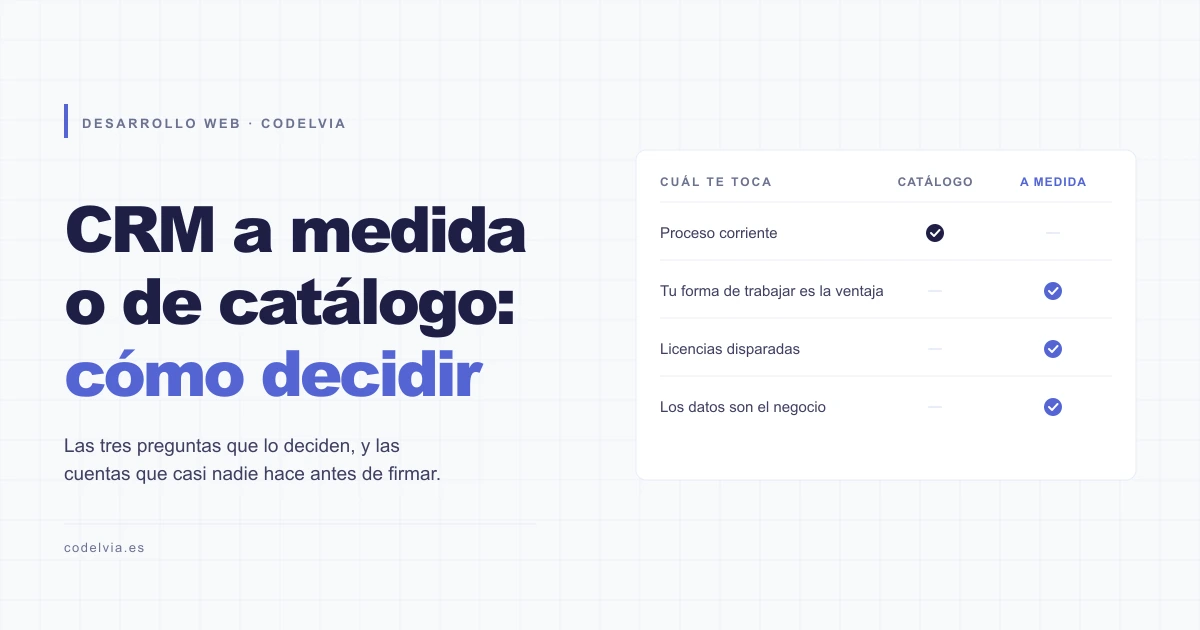
The three questions that decide whether custom development pays off or whether Zoho is plenty. Including the sums almost nobody does before signing.
The conversation almost always starts the same way: "we need a CRM". And from there, two interested answers are waiting. The custom software provider will say off-the-shelf does not adapt to your business. The SaaS salesperson will say custom is hugely expensive and takes months. Both are partly right, and both get paid for what they recommend.
So let us go to the part neither of them tells you: how to decide it yourself.
First, off-the-shelf wins more often than you would think
If what you need is to store contacts, log opportunities, set reminders and see a pipeline, that already exists and costs little. Zoho, Pipedrive, HubSpot on its free tier. They work from day one, somebody else maintains them, and if you do not like them you leave.
Commissioning that as a custom build is paying to reinvent something already solved. And the worst part is not the money: it is that you end up responsible for maintaining it.
We build custom software and this is still the recommendation we give most often. A project that should never have existed ends in an unhappy client, and that costs more than the invoice.
The three questions that actually decide
1. Is your process an advantage or a workaround?
Some companies work in a way that is exactly what makes them better: their own scoring system, a review sequence nobody else does, a way of grouping cases that comes from twenty years of practice. Forcing that into a generic tool destroys it.
And some companies have an odd process simply because nobody ever sat down to tidy it up. That does not need programming: it needs fixing.
The test: if you explain your process to an outsider and they nod, it is an advantage. If they pull a face, it is a workaround.
2. How much are you already paying?
This is the sum almost nobody does. Add the per-user monthly licences of everything you use: the CRM, the ticketing tool, invoicing, e-signature, extra storage. Multiply by twelve. Multiply by three years.
Now add the hours someone spends every month moving data from one place to another, because those tools do not talk to each other. At their hourly cost, not at zero.
That figure is what you compare against. Not the development quote on its own, which always looks expensive in isolation.
3. What happens when someone leaves?
In an off-the-shelf tool, the data sits on their servers under their terms. It can usually be exported, but the format is theirs and so is the account.
For most people that is fine. For a practice with document retention duties, for anyone handling medical records, or for anyone whose data is the business itself, it is not fine at all.
What actually makes a build expensive
Not the programming. It is, in this order:
Building the screens is the cheap part. Anyone quoting you only for that is quoting a third of the project.
The middle road almost nobody suggests
You do not have to choose all or nothing. What works best in small companies is usually to keep off-the-shelf what is already solved — email, storage, invoicing — and build custom only the piece where your advantage lives.
An application that runs your specific process and pulls data from the rest. Cheaper, faster to get working and far less risky than replacing everything at once.
How to tell whether the seller is serious
Ask these four questions, to us or to anyone. If any answer is vague, the vagueness is the product:
In short
Off-the-shelf if your process is ordinary, if licences have not got out of hand and if the data is not the business itself.
Custom if the way you work is what sets you apart, if you have spent years bending it to fit a program, or if what you already pay exceeds what owning it would cost.
And if you are not sure, tell us the process: we will tell you which of the two it is, even if the answer is that you do not need us.
Have a project in mind?
Tell us what you want to achieve.